More than 200.000 barrels of low-level radioactive waste were “dumped” at the bottom of the Atlantic Ocean between 1949 and 1982, according to ScienceAlert.
What happened to those barrels?
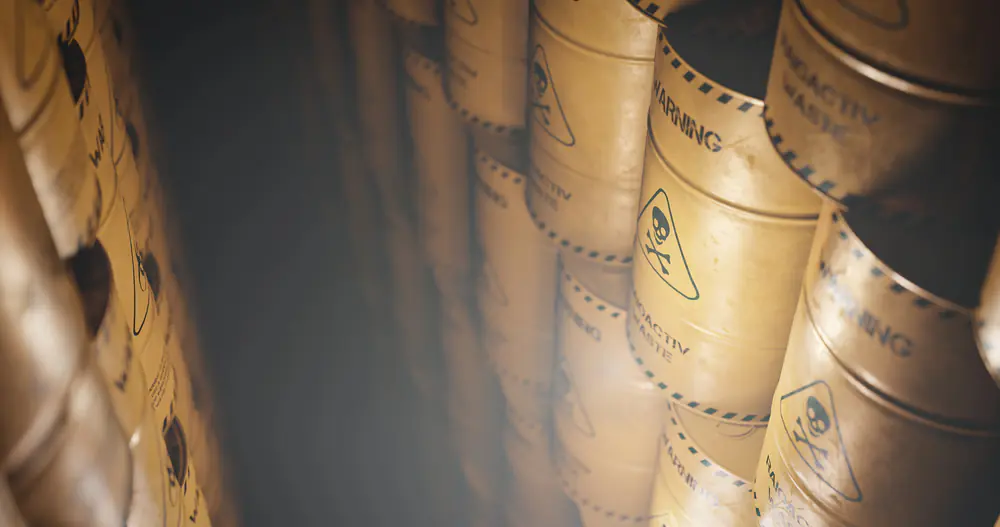
More than 200.000 barrels of low-level radioactive waste were “dumped” at the bottom of the Atlantic Ocean between 1949 and 1982, according to ScienceAlert.
What happened to those barrels?
Scientists dived to the site with a manned submersible to investigate the situation and found that many of the barrels had suffered corrosion and deterioration, with their contents leaking to the seabed.
Surprisingly, this is not necessarily a departure from the original plan… The International Atomic Energy Agency recommends storing low-level waste in durable containers that ensure isolation for at least a few hundred years. However, in the mid-20th century, the recommendations were somewhat different.
The guidelines at the time stipulated that the containers should reach the bottom intact and remain sealed only long enough for the short-lived radioisotopes to decay. The remaining waste was then expected to gradually leak out and disperse into the surrounding ocean. Not all barrel materials decay in this convenient way, however. If they contain a mixture of radioactive substances, such as cesium-137, plutonium isotopes, and tritium, they can remain active for thousands of years…
A few years ago, nuclear engineer Patrick Chardon and marine geologist Javier Escartín, from the French National Center for Scientific Research, began to wonder what the fate of the discarded waste was.
This question ultimately led to the NODSSUM (Nuclear Ocean Dump Site Survey Monitoring) project — an interdisciplinary endeavor that combined nuclear physics, geology, oceanography, biology, and marine chemistry to locate the barrels and investigate their effects, if any, on the environment…
The barrels also seemed to function as tiny oases on the otherwise sparsely populated sandy bottom. Anemones had attached themselves to the barrels. Sponges, sea cucumbers, fish and crustaceans lived around them, with crabs showing a particular preference for these artificial shelters…
The #NODSSUM docked @ Brest Sun 28th. Exciting science: 19 Nautile dives to 4700 m, more than 100 barrels imaged, sediment, biota & water filter, coring, fish traps… peek to photos & videos for a week here:www.swisstransfer.com/d/22d399c8-a…From tomorrow here:sdrive.cnrs.fr/s/t7jH3ofqfk…
— Javier Escartín (@jescartin.bsky.social) 2026-07-02T09:31:26.574Z
Instruments on the ship detected significant signals of cobalt-60 and niobium-94, which researchers were able to directly correlate with the discarded waste... There were, however, signs that even high levels of radioactivity around a source did not necessarily spread over a long distance.
A recent study of the sunken Soviet submarine Komsomolets found that radionuclide levels were hundreds of thousands of times higher than background levels immediately around the leaking reactor—however, these values dropped sharply within a few meters as the material dispersed into the seawater.
Similarly, the NODSSUM team found that despite significant evidence of radioactivity around the barrels, the activity levels were not high enough to pose serious radiation protection issues for the scientists handling the samples. Their three-person submersible, the Nautile, and the instruments it carried showed no sign of contamination.
The real achievement was mapping the exact location of the barrels. “None of this means the waste is harmless,” the article concludes, “but neither does it mean we’re going to be overrun by radioactive crabs.”

Although the press releases will range from very select to rare, I said I'd pass...because sometimes the editors hide.