

Physicist Francis Halzen of the University of Wisconsin-Madison was awarded the 2026 Nobel Prize in Physics for his contributions to the understanding of astrophysical neutrinos. Halzen led the development of the IceCube Neutrino Observatory under the Antarctic ice, which helped trace the origin of high-energy neutrinos to cosmic sources such as supermassive black holes, ushering in a new era of “multi-messenger astronomy.”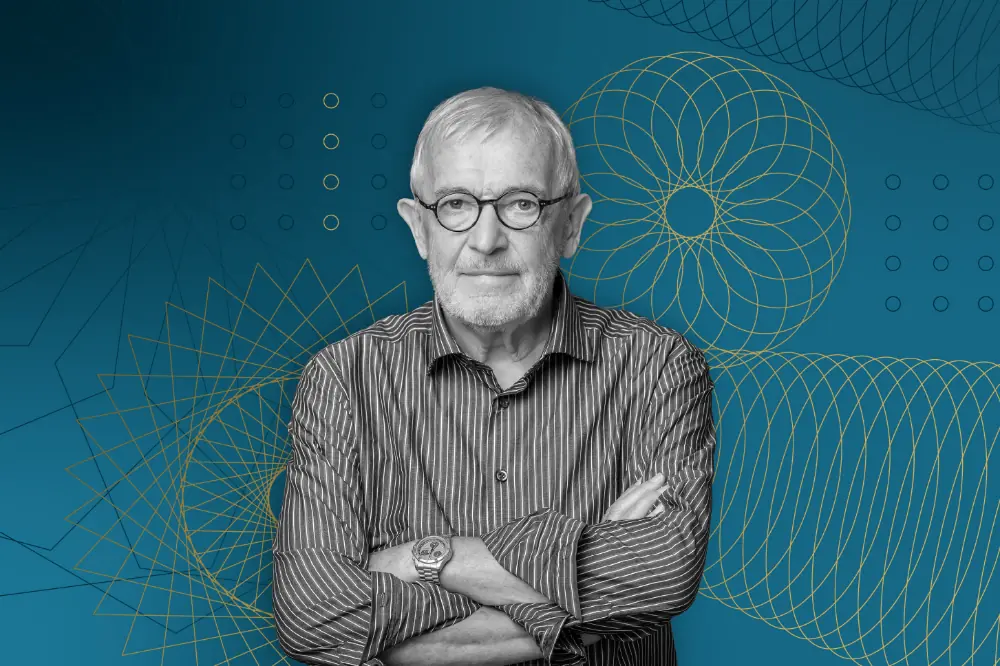
Housed inside a one-cubic-kilometer ice cube in Antarctica, IceCube uses thousands of light sensors to detect neutrinos in the universe — particles with nearly zero mass that rarely interact with other matter. Neutrinos provide information about the workings of black holes, galaxies, and other objects in the universe.
“IceCube is unlike any other telescope in the world,” said UW-Madison Acting Provost Eric M. Wilcots. “And there is no other scientist like Francis Halzen, whose idea to build a neutrino detector beneath a layer of ice nearly a mile thick led to a remarkable multinational and inter-institutional scientific collaboration, as well as a fundamental change in the way we understand the universe.”
Unlike electrically neutral neutrinos, cosmic rays are charged particles whose path cannot be traced directly back to their source.
However, the powerful cosmic accelerators that produce them—such as supermassive black holes—also produce neutrinos. These so-called “ghost particles” travel almost unhindered from their accelerators, giving scientists a near-instantaneous clue to their source. Combined with observations from other telescopes, the neutrino initially detected by IceCube provided the first evidence for the source of high-energy cosmic rays—the origin of which has been notoriously difficult to pin down since their discovery more than 100 years ago by Victor Hess, winner of the 1936 Nobel Prize in Physics.



0 reviews
iGuRu.gr