



Research by Kaspersky Lab and B2B International revealed that 41% of European Internet users have been attacking 12 malware over the past few months. Indeed, in most cases (78%), this has had a negative impact on both users and their devices.
Malware attacks were more often turned against Windows computers, with 83% of Windows computer users reporting that they were affected during the last 12 months. However, Android and Mac OS X users, with 13% and 6% respectively, were not unaware of "infections" on their devices.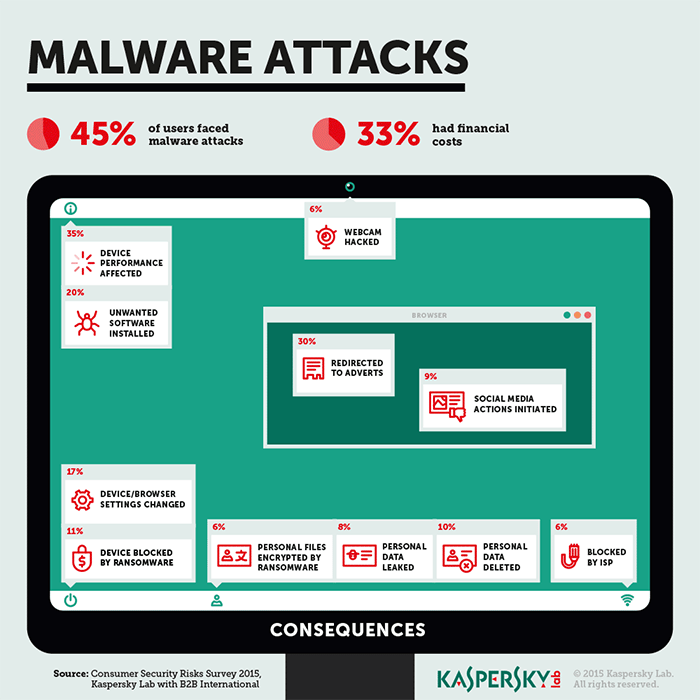
10% of European users believe the device was "infected" after visiting a suspicious site. 5% reported a third-party USB drive as the cause of the infection, 6% reported another "infected" device, while installing a malicious application that was "disguised" into a legitimate program was reported by 7%. Also, 6% said its devices were "infected" after opening an attachment to email. The majority of European respondents (13%) could not explain how the malware came to its device.
It is worth noting that four out of five malware "infections" caused problems for their victims. Most often (32% of cases in Europe), users noticed its performance computer τους να επιβραδύνονται, το 28% των ερωτηθέντων ανέφερε εμπειρίες με ενοχλητικά διαφημιστικά μηνύματα (π.χ. το πρόγραμμα περιήγησης να ανακατευθυνθεί σε ανεπιθύμητες ιστοσελίδες), ενώ το 18% των Ευρωπαίων χρηστών του Διαδικτύου βρήκε στις συσκευές του προγράμματα που δεν είχαν εγκατασταθεί με την άδειά του.
Συνολικά, περίπου ένας στους τρεις (28%) Ευρωπαίους αντιμετώπισε οικονομικές απώλειες ως αποτέλεσμα της «μόλυνσης» από κακόβουλο λογισμικό. Εκτός από τα λύτρα που χρειάστηκε να πληρώσουν στους εγκληματίες, τα θύματα ξόδεψαν χρήματα για την recovery συσκευής ή δεδομένων, αλλά και για λογισμικό εξουδετέρωσης των συνεπειών της «μόλυνσης», ενώ κάποιοι αναγκάστηκαν ακόμη και να αγοράσουν μια καινούρια συσκευή για να αντικαταστήσουν την παλιά. Σε περιπτώσεις οικονομικών απωλειών, το μέσο κόστος μιας επίθεσης ανήλθε στα $140 για τους Ευρωπαίους χρήστες.
"The costs and unpleasant consequences of" malware "infection can be avoided with a little caution. For example, we do not need to place unchecked USB sticks on a device. Also, we should only use official apps bedspread, keep the operating system and applications up to date and scan files with a security solution before opening them. The ability to anticipate potential problems and h λήψη preventive measures are key to keeping a user safe,"explains Peter Aleshkin, Head of Consumer Marketing for its Emerging Markets Kaspersky Lab.
The solutions Kaspersky Internet Security - Multi-Device and Kaspersky Total Security - Multi-Device protect Windows, OS X and Android devices. They are designed to protect users from a wide range of threats, including subtheftof passwords, unauthorized attempts to access webcams, cryptomalware, vulnerabilities of popular applications, etc. Also, Kaspersky Lab's "arsenal" includes free apps for different platforms, so that internet users can check for "infections" or vulnerabilities in their devices.