

If you think you are not an “attractive” enough target for cybercriminals – because you are a simple person, you don’t have much money in the bank and your online activities are routine, ask yourself the following four questions:
Do I have at least one online account of any kind? Do I have a name? Date of birth? Home address?
Of course you have! And all of this is valuable data for cybercriminals.
Today, scams are no longer isolated incidents by lone fraudsters targeting “important” individuals, explains global cybersecurity firm ESET . Instead, they are mass-produced, automated and AI-powered threats that are ever-present and, sooner or later, will arrive at our digital doorstep.
Before the digital age, the saying went that two things were certain in life: death and taxes. Based on the available data and global user experience, perhaps it's time to add "scams" to that list.
Scams are everywhere
US residents recognize cybercrime as a serious threat , but they are not particularly concerned about scams targeting their money – just 37% expect to fall victim to one in the next year. That’s far from the truth.
Overall, fraud is a global threat that cost over $1,03 trillion in 2023 – an amount equivalent to the total GDP of countries such as South Africa, Singapore or Colombia.
According to data from the Global Anti-Scam Alliance (GASA), almost half of the world's population is faced with at least one fraud attempt every week, while the United States records the greatest financial losses, with an average of $3.520 per victim.
The most costly scams targeting individuals, as reported (PDF) to the FBI in 2024:
- Investment scams: 6,6 billions of dollars
- Technical support scams: 1,5 billions of dollars
- Personal data breaches: 1,5 billions of dollars
- Non-payment/non-delivery scams: 0,8 billions of dollars
- Trust/romance scams: 0,7 billions of dollars
True stories
What ESET researchers are seeing is not just the sheer volume of scams, but also their increasing sophistication and seeming credibility. Fraudsters now have tools, such as artificial intelligence, that allow them to create sophisticated scams with less effort than ever before.
For example, in the second half of 2024, ESET telemetry detected a number of scam ads , identified as Nomani — a play on words that refer to “no money.” Using artificial intelligence and deepfakes featuring celebrities like Joe Rogan and Elon Musk, these ads promoted “secret” investment opportunities, miraculous dietary supplements, and alleged legal help. But as the name suggests, those who fell for these scams ended up with no money and no real product or service.
The explosive growth of scams and the availability of supporting resources offered as services in the underworld are also confirmed by tools such as Telekopye — a Telegram bot detected by ESET.
Telekopye is available on the black market for a fee and allows its customers, i.e. fraudsters, to easily create their own fraud campaigns. Its capabilities range from fully automated phishing websites to entire spam email campaigns.
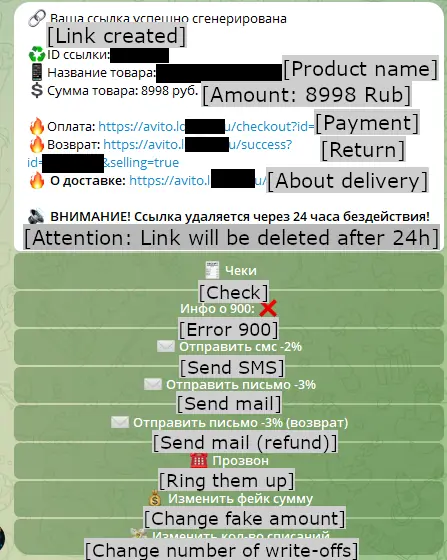
Figure 1: This toolkit , used in Telekopye marketplace scams, creates phishing links for the vendor fraud scenario.
Even if you're among the 67% of people who say they're confident in their ability to spot fraud, remember that some modern practices can go far beyond simple phishing attempts or artificial intelligence-generated ads.
Recently, ESET researchers uncovered a new, multi-layered attack scenario in which cybercriminals combine various fraudulent tactics to impersonate bank employees who supposedly protect customers from cyberattacks. Their real goal, however, is to empty the bank accounts of unsuspecting victims.
This particular scenario includes fake stories, phishing attacks, tech support scams, and a malicious mobile phone app that steals NFC (near-field communications) data used for contactless payments.
Although it may seem that the scope of this complex scenario is limited, cybercriminals have already started testing it on a global scale and have found ways to defraud people en masse.
How to protect yourself
Considering the number of reports, the success rate of financial scams remains alarmingly high (37% in the US and 35% in the UK). This means that from now on, public awareness and risk prevention must become second nature.
Let's highlight the basics:
- Verify before you trust. – Rule No. 1: always verify the identity and request or offer of anyone who contacts you unexpectedly — especially if they ask for money or personal information.
- Educate yourself and your family – Learn to recognize the most common scams and encourage your family members to discuss any suspicious incidents they encounter so you can deal with them together.
- Protect your accounts – Make sure all your family’s online accounts have strong, unique passwords. Enable two-factor authentication (2FA) where possible.
- Stay informed – Keep your software — including cybersecurity programs — up to date. Don’t forget to update your router too.
| Protection for very small businesses |
| Because they handle personal and financial data collected from large numbers of individuals but lack the resources to hire cybersecurity professionals, small offices or home offices (SOHOs) are even more attractive targets for fraudsters compared to individuals and households.
Often, SOHO administrators don't even understand the potential threats . Even those who do understand them often lack the confidence to address them — mainly due to limited budgets. For example, 41% of UK micro businesses (i.e. those with 1 to 9 employees) suffered a data breach or cyberattack in 2024. A third of these incidents were phishing attacks. However, more than 30% of these businesses still considered cybersecurity a low priority. |



0 reviews
iGuRu.gr