How they steal your child's information for loans in their name

We often worry about what content our children see online or how much time they spend on screens. “But these are not the only digital dangers,” says Phil Muncaster on WeLiveSecurity, the information platform of cybersecurity company ESET. “There is another one that is right in front of our eyes, but we ignore it: the fact that children are at risk of the same problems that we are at risk of, such as identity theft, privacy violations, data theft. In fact, they may be at even greater risk. That is why it is important to teach them from a young age how to protect their personal information and their accounts on the Internet,” informs the Phil. loan

But why would scammers want my children's personal data?

Children have grown up in a digital world. From a very young age, they may have logins to school accounts, game profiles, photos stored in the cloud , medical records, and app accounts. All of this contains personal data that can be particularly valuable to identity thieves.

See more articles from iGuRu.gr when you search for news on Google.

But why is this information such a popular target? Because, from a fraud perspective, it has a long “lifespan.” If it is stolen and used in banking fraud, it is very likely that the victim will not find out until many years later, when, for example, he applies for his first loan. In addition, the child will have an impeccable credit history, which increases the chances of the application being approved without special checks. Fraudsters can either use the information as it is or combine it with fake data, creating so-called synthetic identities.

The emergence of artificial intelligence ( AI ) tools has made it even easier to create such fake identities, while making it harder for companies to detect them. But when the fraud is discovered, the consequences for a child's credit history can be particularly serious.

These risks are not theoretical. A report presents the case of Renata Galvão , a risk management and compliance professional , whose identity was stolen when she was just six years old and used to create a debt that exceeded $400.000. According to the same information, it took more than twenty years to clear her name and restore her creditworthiness.

In another case, Axton Betz - Hamilton was just 11 years old when her identity was used to rack up thousands of dollars in unpaid credit card debt. She only discovered this when, as a college student, she tried to open her first bank account.

Although data is difficult to find, the United States Federal Trade Commission (FTC) claims that incidents of child identity theft increased by 40% between 2021 and 2024.

What can go wrong?

Children’s data is at risk in other ways too. While children are often very familiar with the digital world and easily create online accounts, they are not always careful about security. They are more likely to fall victim to phishing emails , especially when they appear to come from a trusted source or a friend. Offers that seem “too good to be true,” seemingly innocent quizzes, and ads that exploit the FOMO ( Fear of Missing Out ) phenomenon are more likely to mislead a gullible 13-year-old than an adult.

Children are also more likely to unknowingly download malware onto their devices or share passwords and personal information with their peers, increasing their security risk.

113w

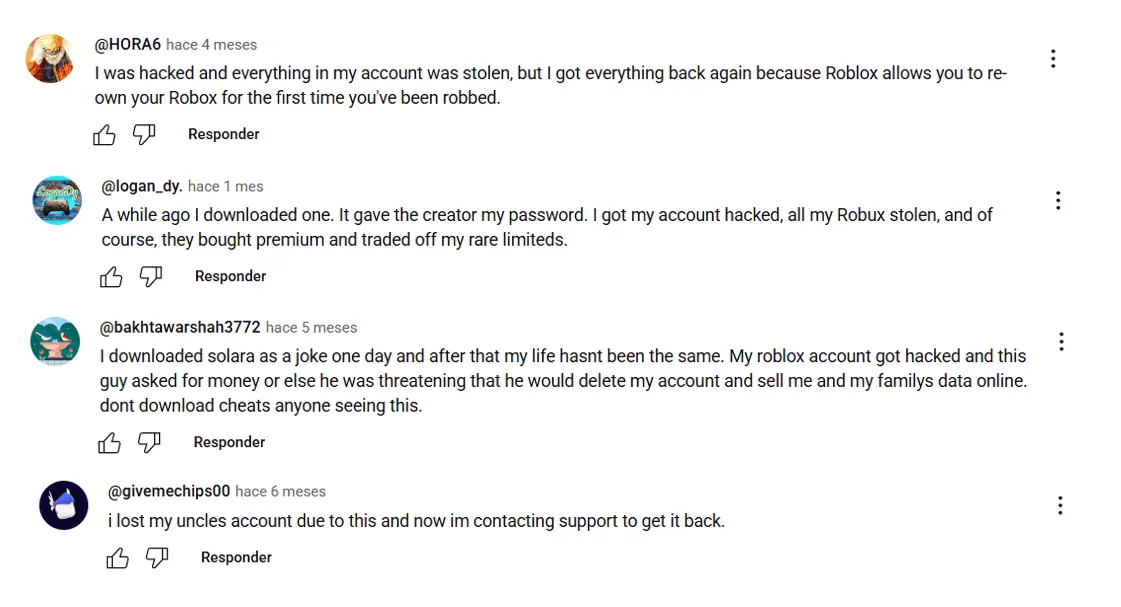
Roblox users share their experiences after downloading fake versions of Solara . Source: YouTube

But children are not the only potential weak link in the digital security chain. A study by the University of Southampton last year found that almost half of parents (45%) regularly share information about their children online. This practice increases the risk of their personal details ending up in the hands of fraudsters. According to the same study, around one in six children have already experienced at least one incident online, such as bullying, privacy breach or identity theft.

At the same time, the risk of breaches of the systems of organizations that manage children's data is also increasing. Educational platforms, school platforms, game providers, manufacturers of "smart" toys, social networking companies and other businesses that manage personal data may themselves fall victim to cyberattacks.

The nonprofit Identity Theft Resource Center (ITRC) recorded 3.322 data breaches in the U.S. last year, a record number and a 79% increase from five years earlier. The data of nearly 279 million people was exposed, with the healthcare and education sectors among those hardest hit.

The rapid spread of artificial intelligence ( AI ) applications also creates new privacy risks. Many children use AI tools without realizing that they may be sharing sensitive information, which could be exposed in the event of a provider breach.

Online gaming accounts are also a particularly attractive target for fraudsters , as they often contain valuable information, such as:

  • Credit card details or other financial data, which can be used for fraud.

  • Contact details, which can be used to send spam or phishing attacks to other children.

  • Digital items (skins) that can be stolen and resold.

  • Private conversations that may contain financial or personal information.

All of this creates a wide range of risks to which your child's personal information may be exposed.

How to determine if a breach has occurred

There are several ways to check if your child's identity or personal information, including login details, has been stolen. The following are signs that should concern you:

  • Passwords suddenly stop working, which could mean that someone has gained access to the account and changed the login information.

  • Skins , digital currencies, or other items have disappeared from the child's game account.

  • You receive notifications for account changes, new logins, or password resets.

  • Purchases that you have not approved are appearing.

  • Friends or contacts report strange activity or suspicious messages sent from the child's account.

  • An application for a student loan or to open a bank account is rejected due to low creditworthiness.

  • The child receives a notice from the tax authorities about debts or unpaid taxes because someone is using their details.

  • You receive phone calls or correspondence regarding overdue debts that have been created in the child's name.

It is a shared responsibility.

Protecting children’s identity data is the responsibility of many different parties. Parents have the most important role, but equally important are schools, app developers, device manufacturers, and any organization with which children share personal information. None of these can, on their own, ensure the security of personal data.

So what can you do as parents? Limit the sharing of personal data, securely configure account settings, and teach your child best practices.

Start with the data itself. Ask yourself if it’s really necessary to create a new account, grant permissions to a school app, or post photos and videos of your child online. Data minimization is a core principle of the General Data Protection Regulation (GDPR). The less personal information that’s circulating online, the less likely it is to end up in the wrong hands.

Next, strengthen the security of the accounts your child already uses. Choose strong, long, and unique passwords for each account and store them in a family password manager. This reduces the risk of brute force attacks . Also enable multi-factor authentication ( MFA ), where available, to reduce the risk of phishing attacks.

Review the privacy settings on all apps and social media platforms your child uses and choose the safest settings available. Limit or disable location sharing, require your approval for in-app purchases, and keep all devices and apps up to date to make them less vulnerable to cyberattacks. At the same time, leverage available parental controls to monitor usage and limit sharing of sensitive data.

Finally, take the time to talk to your children about the importance of protecting their digital identity. Explain to them what is at stake, how cybercriminals can obtain and exploit their personal data, and what the most common phishing techniques are . Teach them the basics of creating and managing strong passwords, as well as how to recognize suspicious activity online. Above all, make sure they feel they can talk to you openly about anything that happens to them.

Protecting your child's identity doesn't mean you have to limit their digital world. It means giving them the tools and confidence to explore it safely, both today and in the future.


Google preferences

Leave a Comment

Your email address will not be published. Required fields are marked *

Your message will not be published if:
1. Contains insulting, defamatory, racist, offensive or inappropriate comments.
2. Causes harm to minors.
3. It interferes with the privacy and individual and social rights of other users.
4. Advertises products or services or websites.
5. Contains personal information (address, phone, etc.).