How is Greece doing in digital sovereignty?

Digital sovereignty is not yet the buzzword of the era, but it is getting closer to becoming one. Especially in Europe, which essentially invented it.

europe

The term digital sovereignty originally focused on the idea that data collected in a particular region or country should stay there, for the purpose of managing consumer data. The EU is increasingly enforcing the term. Recently, however, the definition has expanded beyond simple data retention to encompass the entire ability of a country or region to regulate its digital infrastructure or technology policies independently and without external influence or interference.

See more articles from iGuRu.gr when you search for news on Google.

Although the EU has traditionally been the epicenter of digital sovereignty, the concept has recently gone global, with China, Russia, and India — along with Brazil and Argentina — developing their own forms of digital sovereignty with their own data storage and other regulatory policies.

“While the conversation is global, the actual state of digital sovereignty varies significantly between countries,” Nextcloud senior communications manager Christoph Weissthaner wrote in a blog post Thursday . “There may be policies, but how much infrastructure is actually running locally, rather than in the cloud? What choices are people making? And how does that compare to public sector policy?”

The blog post aimed to present something Nextcloud calls a Digital Sovereignty Index — a look at the tools used by country through a lens of sovereignty.

This is of interest to Nextcloud, as the self-hosted cloud platform allows organizations to control both their data and the software that manages it. The survey highlights the number of self-hosted collaboration applications in use in nearly 60 countries.

“We selected 50 of the most relevant self-hosted tools for digital collaboration and communication,” said Christoph Weissthaner. “These include platforms for file sharing, video conferencing, groupware, note-taking, project management, and more. We then measured their real-world usage by counting the number of identifiable server instances per country.”

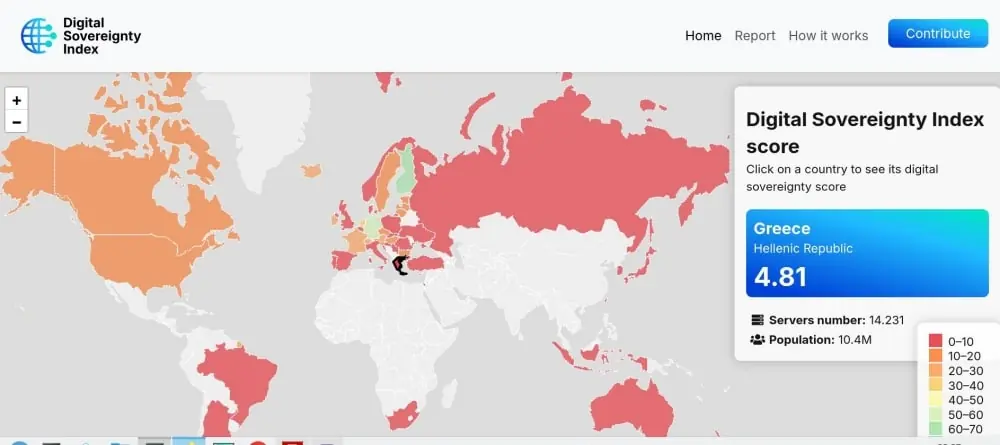
Each country's score reflects how many of these relevant self-hosted tools are used relative to that country's population, with higher numbers indicating a greater potential capacity for digital dominance.

Greece is not doing so well.

You can see the countries you are interested in from here


Google preferences

Leave a Comment

Your email address will not be published. Required fields are marked *

Your message will not be published if:
1. Contains insulting, defamatory, racist, offensive or inappropriate comments.
2. Causes harm to minors.
3. It interferes with the privacy and individual and social rights of other users.
4. Advertises products or services or websites.
5. Contains personal information (address, phone, etc.).