

Researchers in Vienna and Beijing have independently built the first nuclear clocks that use oscillations inside thorium nuclei, marking a major milestone for a field that could eventually lead to the creation of highly portable and ultra-precise timekeeping instruments.
These clocks are already so accurate that they lose just one second over millions of years.
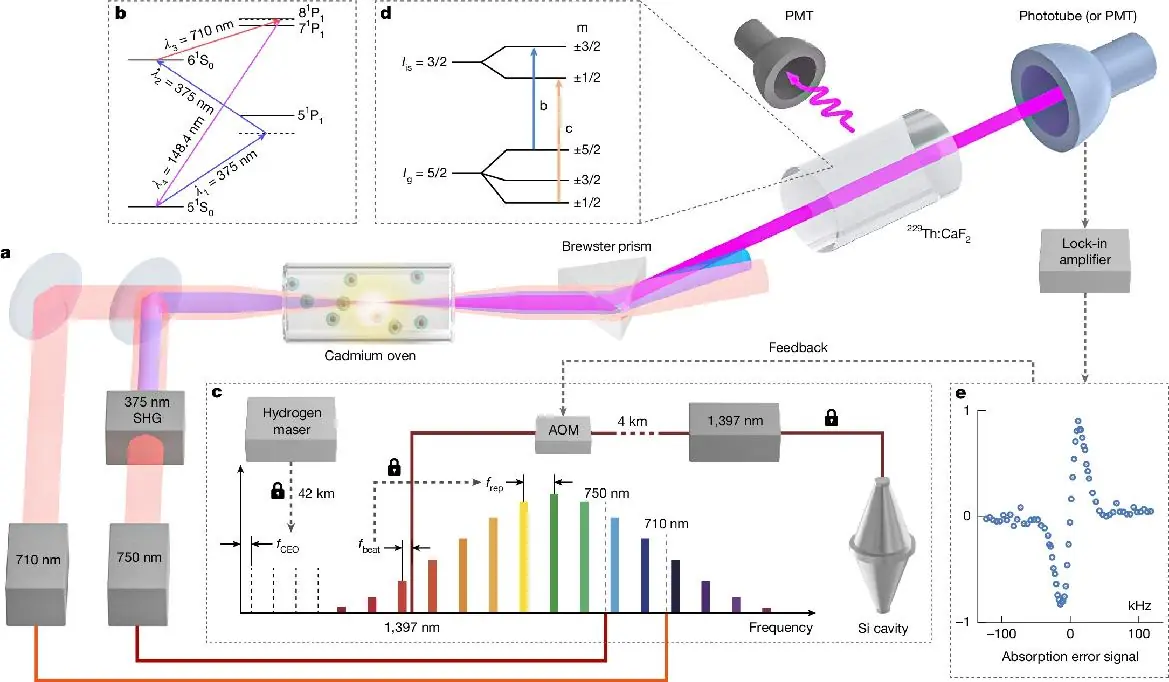
image nature.com
Τα πρώτα πυρηνικά ρολόγια δεν πρόκειται να αντικαταστήσουν άμεσα το παγκόσμιο network ατομικών ρολογιών, στη σταθερή λειτουργία των οποίων βασιζόμαστε για το GPS και τον ορισμό του δευτερολέπτου. Ούτε κατέχουν το ρεκόρ ακρίβειας: τα κορυφαία ατομικά ρολόγια είναι περίπου 10.000 φορές πιο αξιόπιστα και θα χρειάζονταν πάνω από 100 δισεκατομμύρια χρόνια για να χάσουν ένα δευτερόλεπτο.
However, nuclear clocks present a number of potential advantages over existing atomic clocks.
They may eventually become more reliable than the top-of-the-line atomic versions, while also offering the potential for greater portability. They also have the potential to detect certain types of dark matter — that invisible substance whose clumps make up 83% of the matter in the universe.
If a dark matter particle were to pass through the thorium nuclei, its presence would be recorded as a small fluctuation in the otherwise steady rhythm of the nuclear clock.
The findings were published in the scientific journal Nature.
DOI: https://doi.org/10.1038/s41586-026-11122-1



0 reviews
iGuRu.gr