

Proton, the company behind the provider of the same name Email Proton Mail: , has gained a loyal fan base of dissidents, investigative journalists and others who want to stay away from the prying eyes of the government or big tech companies. Based in Switzerland, the service calls itself “a neutral and safe haven for your personal data, dedicated to defending your freedom.”
At one point (in December 2024), however, Proton CEO Andy Yen praised the Republican Party in a post on X , stating that “10 years ago, Republicans were the party of big business and Democrats supported small business, but today things have completely flipped.”
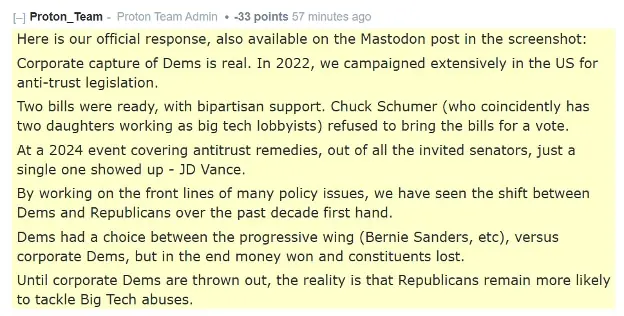
When the tweet went viral, Proton's official Reddit account posted a now-deleted comment that said, "Until corporate Democrats are prosecuted, the reality is that Republicans remain more likely to confront the abuses of big tech companies."
Within hours, Proton deleted its response across all social media accounts, stating that the post – which began with the words “This is our official response” – was in fact “removed because it was not an official statement.” The response went on to say: “Our policy is that official accounts cannot be used to express personal political views. If this happens by mistake, we will correct it as soon as we notice it.”
Yen later claimed the post was an "internal misunderstanding", later writing that Proton is "politically neutral".
He followed up with a more extensive statement explaining that “while we may share facts and analysis, our policy going forward will be to not share opinions of a political nature. The line between facts, analysis, and opinions can be blurred at times, but we will seek to better clarify it over time through your comments and suggestions.” Yen did not specifically address whether the deleted post was an opinion or analysis.
Proton later reiterated its claim that it is a “politically neutral organization” and then stated that “regardless of one’s opinions on the broader Republican platform, if you agree that action is needed on antitrust, then the appointment of Gail Slater is a positive thing,” referring to President Donald Trump’s pick to lead the Justice Department’s antitrust division. Proton further stated that “The CEOs of big tech companies are tripping over themselves to kiss the ring precisely because Donald Trump represents an unprecedented challenge to their monopoly dominance.”
When governments ask for data
Yen has repeatedly described Proton as a company that “prioritizes privacy,” and its homepage boasts that “With Proton, your data belongs to you, not tech companies, governments, or hackers .”
However, Proton has previously disclosed user information to authorities. For example, Proton handed over an IP address at the request of French authorities that was submitted via Europol to Swiss police. Yen wrote on Twitter at the time , stating: “Proton must comply with Swiss law. Once a crime is committed, privacy protection can be suspended and we are obliged by Swiss law to respond to requests from Swiss authorities.”
Proton’s law enforcement information page states that a copy of a “police report or court order,” whether foreign or domestic, is required. For its part, Proton told The Intercept that “Proton does not comply with U.S. subpoenas, whether Biden or Trump is in power.”
While Proton states that it “cannot read any of your messages or deliver them to third parties,” the same does not apply to email subjects, sender or recipient names and email addresses, the time a message was sent, or other information in the email header. Proton explicitly states that “if we are served with a valid Swiss court order, we may deliver the subjects of your messages.”
During Trump’s previous term, the Justice Department sought to secretly obtain “non-content” communications, such as phone call and email records, of journalists at various news outlets such as CNN and the New York Times. While the subject line of an email is considered “content,” non-content includes metadata such as the date and time a message was sent, as well as the sender and recipient of an email.
The past behavior of a Trump-led Justice Department, combined with the praise and efforts by tech CEOs to curry favor with the Trump camp, raises the question of how vulnerable the industry will be to data requests from the new administration.
It's a particularly important question for the types of users who flock to Proton – the kind who fear exposing sensitive sources, people being deported, or people under state surveillance.
“Platforms inherently hold a position of trust because we want them to support users when the government requests data,” said Andrew Crocker, director of surveillance litigation at the Electronic Frontier Foundation , which has published an annual report titled “Who’s Supporting You?” that analyzes companies’ compliance with government requests for user data.



0 reviews
iGuRu.gr