

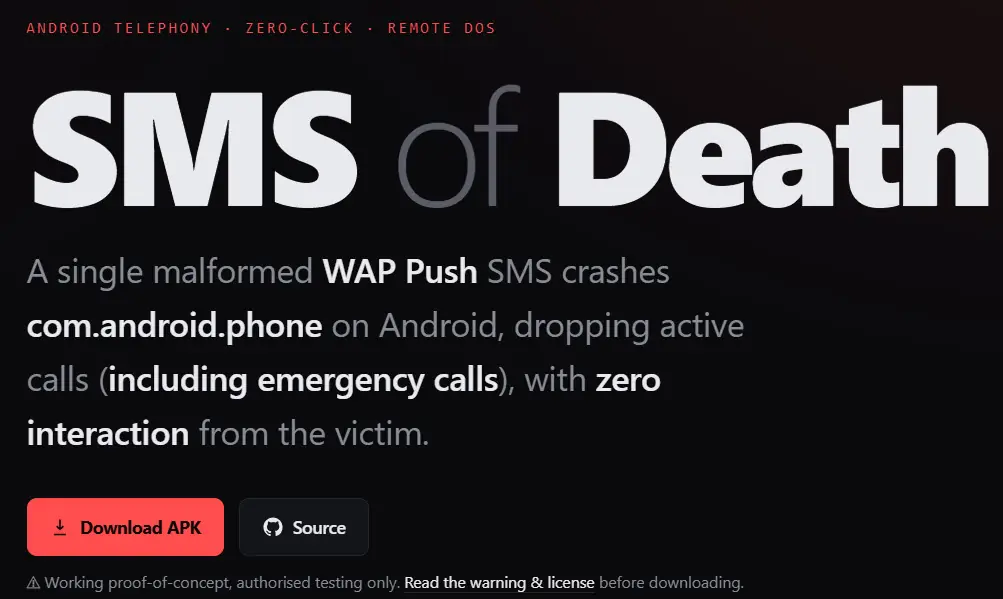
The security researcher Mark Blaszczyk revealed on Thursday a serious security flaw in AndroidThe vulnerability, which it has dubbed “SMS of Death,” appears to affect Android versions 12 through 17. A single text message can render an Android phone inoperable, requiring a factory reset or a complicated recovery process. Older versions of Android 12 and 13 will likely remain unaffected. patch.
Zero-click (no user interaction)
According to Blaszczyk, the flaw is “a zero-click remote denial of service (DoS) attack with permanent effects.” If the flaw is not fixed, the phone will reboot approximately every 90 seconds and display a message prompting it to erase data (in recovery mode). An inexperienced user could be forced to factory reset the device—erasing all of its data—in order to use the device again. According to the researcher, this falls within the definition of a “Destructive Remote DoS” attack, according to Google’s Vulnerability Reward Programs (VRP) rules.
According to its description, it only takes a single bad WAP Push SMS message to crash the “com.android.phone” telephony service on Android. The cause is an uncontrolled type cast: a malformed value in the WSP header is converted to a negative array size, causing a NegativeArraySizeException error that is not handled properly by the system. As a result, active calls — and emergency calls — are dropped, and the victim can do nothing to stop it. The attack is invisible, and the attacker’s “fatal” messages do not appear in the inbox.
WAP Push is an outdated system that allows mobile carriers to send hidden commands to phones without requiring any action from the user. For example, it can instruct devices to download MMS messages or apply carrier settings. If a phone is affected, the researcher says that recovery requires connecting it to a computer via the Android Debug Bridge (ADB). Anyone who sees the recovery prompt should not select “Wipe data ” under any circumstances, as all data will be lost.
The researcher says that Android tries to reprocess the same malicious message every time the phone reboots, causing the system to crash repeatedly. According to Blaszczyk, it only takes about 20 such messages to render a phone practically unusable, trapping it in an endless reboot cycle.
No fix expected for Android 12 and 13
Blaszczyk says he notified Google of the vulnerability on May 5. The issue is now identified as CVE-2026-58882. Google deployed a fix on June 15, which appears to have been incorporated into the code on August 5, but wasn't pushed to the public AOSP repository until October. According to GrapheneOS, Google had already released a patch via security previews in July — months before the researcher publicly disclosed the flaw. GrapheneOS also implemented the fix in July.
Finally, in October, Google released a security update for Android versions 14 to 17, but it was not included in the October security patch. The vulnerability is expected to be fixed in the upcoming November patch, which is rated “critical.” In the meantime, many devices remain vulnerable, as security updates are typically distributed by device manufacturers.
The bug is likely to persist on older devices still running Android 12 and 13 unless manufacturers roll out a proper patch. In any case, Google no longer supports Android 12 and 13.



0 reviews
iGuRu.gr