

If you've been following the developments around Telegram , you'll know that the platform entered 2026 under the most pressure it has ever faced. Following the arrest of CEO Pavel Durov in late 2024 and the introduction of stricter policies in 2025, the platform dramatically tightened its controls: millions of channels were taken down, bans multiplied, and for the first time there was so much transparency about how the measures were implemented.
Yet this “crisis” has not led to a reduction in criminal activity. Instead, networks have adapted — and faster than the platforms can keep up.
Based on new data from Check Point Exposure Management , below are three key developments in Telegram since the 2026 crackdown.
- Record checks, but no substantial reduction in criminal activity
The numbers are impressive. In 2025 alone, over 43,5 million channels and groups were blocked. And in 2026 the situation became even more intense: daily “removals” rose from around 10.000–30.000 to 80.000–140.000, and in some cases even exceeded 500.000 in a single day.
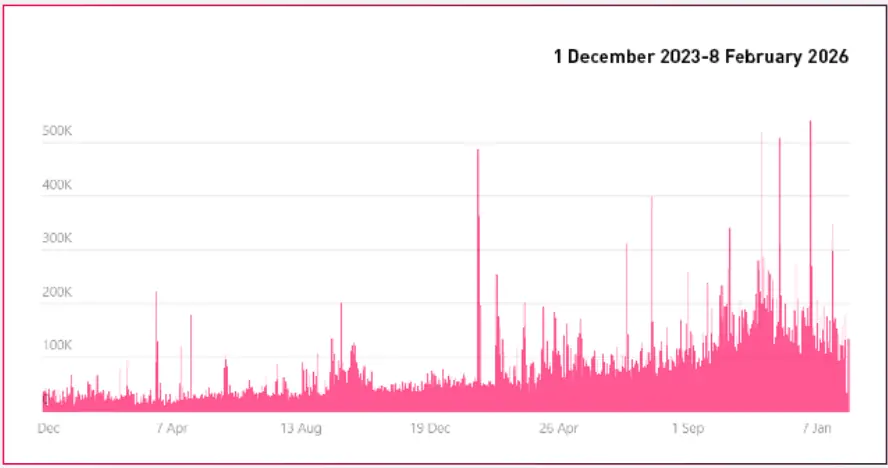
At first glance, this appears to be unprecedented progress. In practice, however, the picture is more complex.
Check Point Exposure Management analysis shows that approximately 20% of the blocked channels were associated with criminal activity that directly affects businesses — such as carding, “Fullz” trading, and hacking services . At the same time, thousands of messages referring to these channels continue to circulate, mainly through forwarded messages, keeping the “knowledge” alive even after they are taken down.
The main problem is the resilience of these networks. Channels may disappear, but communities reappear very quickly. In many cases, alternative channels are already in place before the takedown, so the transition is immediate. In fact, often the audience has already been transferred there, ensuring continuity of activity. Enforcement actions have increased the difficulty, but have not eliminated the use of Telegram by cybercriminals.
- Threat actors are adapting faster than platforms can react
Instead of abandoning Telegram, cybercriminals have evolved the way they operate within it.
Today, we consistently see specific techniques for avoiding detection in “underground” communities. Many groups use features like “Request to Join” to block automated monitoring tools (bots). Others add disclaimers to their channel profiles, even tagging Telegram’s administration, trying to show that they are operating “within the rules” while in reality engaging in illegal activities. At the same time, they create backup channels in advance — often organized into “packages” — so that they can be restored immediately after a takedown.
Check Point data shows an increase in forwarded messages referring to blocked sources, particularly during periods of intense repression, such as February, March, and April 2025. In other words, illegal content continues to circulate even when the original sources have been removed, extending the “life” of both the fraud data and the related instructions.
This adaptability reflects a broader trend in cybercrime. Attackers no longer rely on a single channel or tool. They take disruptions for granted and build alternatives from the ground up. Telegram, thanks to its scale, usability, and ease of content discovery, remains particularly attractive for such practices.
Understanding these patterns of behavior is critical for a more proactive defense. The related ebook analyzes in more depth how these evasion techniques evolve and why they matter to security teams in enterprises.
- Telegram remains the main communication "hub" for cybercrime
If the increased controls had truly driven away criminal communities, we would have seen a clear movement of them to other platforms. But that is not happening.
Despite some limited testing with alternatives, Telegram remains the primary platform of choice. In the last three months alone, Check Point Exposure Management detected approximately 3 million Telegram invite links circulating on underground networks. In comparison, Discord accounted for less than 6% of this volume, while platforms like Signal, SimpleX, and Matrix-based solutions had almost no presence.
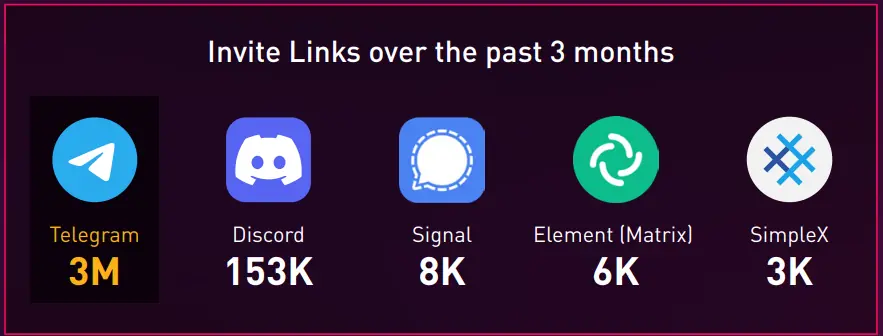
Even attempts to move “large” groups have failed. A typical example is the AKULA group, which was temporarily moved to SimpleX in early 2025, but returned to Telegram when its users did not follow en masse. Some now use alternative applications for one-to-one communication, but Telegram remains the main channel for broadcasting, attracting new members and “buying and selling”.
Network effects play a crucial role. With more than 800 million active users, Telegram has a scale that is hard to rival for any other platform. The controls may have changed user behavior – but not their preference.
For SOC teams, this means that Telegram remains a critical area for exposure management, brand protection, and early threat detection. Ignoring it creates “blind spots” that attackers can easily exploit.
Is the repression on Telegram really real?
The crackdown is real, ongoing, and growing. But so is the adaptability of cybercriminals. While takedowns remain important, it is becoming increasingly critical to identify the broader network surrounding a channel or account.
Security teams that rely solely on platform actions will be left behind. In contrast, those that invest in continuous monitoring and intelligence-driven analysis can map the entire structure of an attack and take down not just individual channels, but entire networks.


0 reviews
iGuRu.gr